Before you start
The WH-347 is the Department of Labor's optional form for the weekly certified payroll that contractors and subcontractors must submit on federal and federally assisted construction projects covered by the Davis-Bacon and Related Acts. The form itself is optional, but the information is not: you may submit it in another format only if that format contains the same information and is accompanied by the same signed statement of compliance.
Use the current version, Rev. January 2025 (OMB No. 1235-0008, expires 01/31/2028). The approval for the older version expired on September 30, 2026. Have these ready:
- The contract or project number, and the wage determination number(s) and modification incorporated into the contract.
- Timesheets with each worker's hours per day and per classification.
- The payroll register for the week: rates, gross pay, every deduction and net pay.
- Fringe benefit plan details: plan names, types, plan numbers, whether each is funded, and the hourly credit you claim for each worker.
- For apprentices, the registered program's name, whether it is registered with the Office of Apprenticeship (OA) or a State Apprenticeship Agency (SAA), and each apprentice's level.
The examples below come from a sample WH-347 that PrevailReady generated from a sample payroll file. Names and figures are fictional.
The header

- Final payroll
- Check "Submission of final DBRA certified payroll form" only on the payroll for the last week of work on the project.
- Prime or sub
- Check whether this payroll comes from the prime contractor or a subcontractor.
- Project name
- The name of the project you are reporting on.
- Project or contract no.
- The project number or the prime contract number associated with your contract.
- Certified payroll no.
- Number payrolls in sequence for each project, starting with 1, based on the weeks worked under the contract.
- Business name and address
- Your business's legal name and full address, as the prime contractor or subcontractor submitting this payroll.
- Project location
- The complete address of the project. If there is no specific address, describe the location, including at least the county or counties and the state.
- Wage determination no.
- The wage determination number and revision included in the contract. More than one may apply.
- Week ending date
- The last day of the workweek for this pay period.
Worker columns 1A to 5
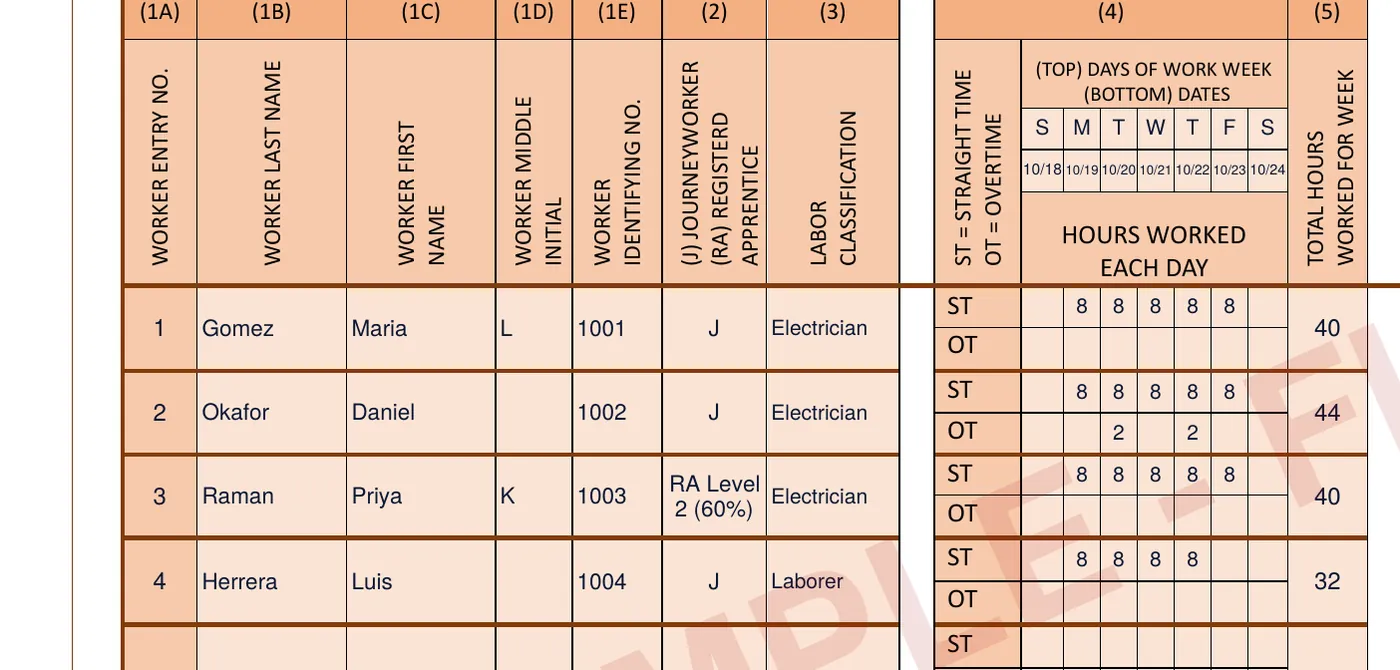
- 1A Entry no.
- Number each worker starting at 1. A worker listed on more than one line, because they worked in more than one classification, keeps the same entry number on every line that week.
- 1B to 1D Name
- Last name, first name and middle initial.
- 1E Identifying no.
A unique identifier such as the last four digits of the worker's Social Security number or an employee number.
Never enter a full Social Security number on a weekly payroll.
- 2 J or RA
- "J" for a journeyworker, "RA" for a registered apprentice. For an apprentice, also give the level of progression in the program.
- 3 Classification
The labor classification for the work actually performed, as listed in the wage determination.
A worker who worked in several classifications gets a separate line for each one. If hours by classification are not tracked, DOL requires paying all hours at the highest applicable rate.
- 4 Hours each day
- In the top rows, the first letter of each day of your workweek; below, the dates. Then straight-time hours (ST row) and overtime hours (OT row) for each day. Overtime means hours over 40 in the week in total, including work on and off the covered site.
- 5 Total hours
- The sum of the hours in column 4 for that line.
Pay columns 6A to 9
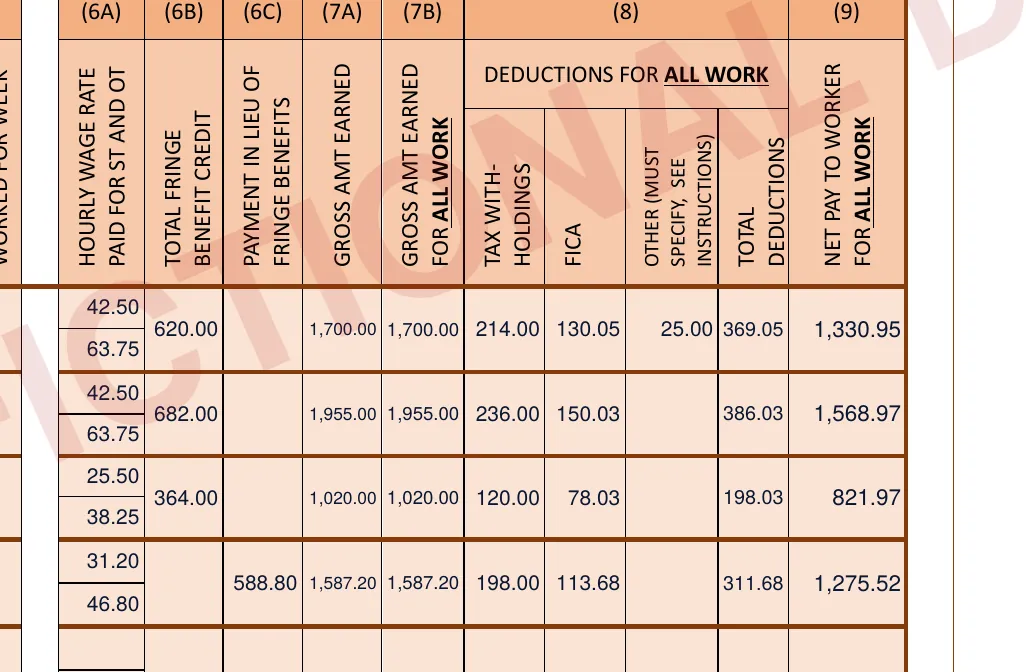
- 6A Rates paid
- The actual hourly rate paid for straight time (top) and overtime (bottom). Do not include cash paid in lieu of fringe benefits here.
- 6B Fringe credit
Total hours worked multiplied by the worker's total hourly fringe credit from the table on page 2.
Example: 40 hours × $15.50 per hour in plan credits = $620.00, as on line 1.
- 6C Cash in lieu
- The total cash paid in place of fringe benefits during the week: total hours multiplied by the hourly cash amount. On line 4, 32 hours × $18.40 = $588.80.
- 7A Gross, this project
- The gross amount earned for the week for hours worked on this project.
- 7B Gross, all work
- The total gross earned during the week for all work, including work on other projects and non-covered work.
- 8 Deductions
Tax withholdings, FICA, other deductions and the total, for all work in the week. Do not pro-rate deductions across projects.
Describe a single "other" deduction under Additional Remarks. If a worker has more than one, DOL asks for an addendum that itemizes each deduction with a description and amount. Deductions must be permissible under 29 CFR part 3.
- 9 Net pay
- The actual amount paid to the worker for all hours worked across all projects during the week. It should equal 7B minus total deductions.
Page 2: the statement of compliance
Page 2 repeats the project details and adds the certifying official's name and title: the person who paid or supervised the payment of the workers for the week. Then you certify the statements by checking each box:
- The payroll is correct and complete, and wage and fringe rates paid, including credit for bona fide fringe benefit plans, are not less than the wage determination requires for the work actually performed.
- All regular payrolls and basic records for the period are complete and accurate and will be made available on request.
- The classification reported for each worker is the work that worker actually performed.
- Any workers paid as apprentices are registered in a bona fide registered apprenticeship program. List the program name, OA or SAA, and the classification. If no apprentices worked, enter "Not applicable" or "N/A".
- Fringe benefits were paid in cash or to bona fide plans. If you claim a credit for plan contributions, fill in the plan table.
- All workers were paid the full weekly wages earned, with no rebates or deductions other than those permitted by 29 CFR part 3.
The fringe benefit table
For each plan you take credit for, enter the plan name, type and plan number, and mark it funded or unfunded. Then, for each worker named on page 1, enter the hourly credit claimed under each plan and the total hourly credit. That total is what column 6B multiplies by the hours. Credit for an unfunded plan requires prior approval from the Department of Labor. If you provide more than six plans, list the rest on an addendum.
Remarks and signature
Additional remarks is optional space for information on deductions, the hourly cost of fringe benefits, or explanations. Then sign and date, with a telephone number and email address. DOL accepts legally valid electronic signatures that show acceptance of the payroll and let the signer's identity be verified; photocopied or scanned signatures do not count.
Mistakes that get payrolls sent back
- Overtime on the wrong base. Overtime is due at 1.5 times the worker's regular cash rate, which can never be less than the basic hourly rate in the wage determination. Fringe benefits are not multiplied, but any fringe not covered by plan credits must still be paid in cash for overtime hours.
- Fringe credit that does not match page 2. Column 6B must equal total hours times the total hourly credit in the page 2 table.
- Full Social Security numbers in column 1E.
- Apprentices without program details, or apprentices paid apprentice rates without being registered.
- One line for a worker who worked two classifications, at the lower rate.
- Net pay that does not add up because an "other" deduction was left off or not itemized.
- Skipping weeks or numbers. Payroll numbers run in sequence for each project.
Fill it from your payroll instead
PrevailReady builds both pages of this form from your payroll data in a CSV or Excel file. It checks journeyworker lines for underpayments, refuses full Social Security numbers, flags apprentices without a listed program and net pay that does not add up, and leaves the signature to you. See how it works.
Frequently asked questions
Is the WH-347 mandatory?
No. The form is optional, but contractors and subcontractors on Davis-Bacon covered projects must submit the same payroll information every week, with a signed statement of compliance, in whatever format the agency accepts.
Who submits the WH-347?
Each contractor and subcontractor prepares its own weekly certified payroll. The prime contractor is responsible for collecting subcontractors' payrolls and submitting them to the contracting agency, or to the applicant, sponsor or owner when the agency is not a party to the contract.
What goes in the identifying number column?
An individual identifier such as the last four digits of the worker's Social Security number or an employee number. Full Social Security numbers must not be included.
How do I calculate the total fringe benefit credit in column 6B?
Multiply the worker's total hours worked by the total hourly credit claimed for that worker in the fringe benefit table on page 2. For example, 40 hours at a $15.50 hourly credit is $620.00.
Can I sign the WH-347 electronically?
Yes, with a legally valid electronic signature that shows acceptance of the payroll record and allows the signer's identity to be verified. A photocopied or scanned signature does not meet the requirement.
This guide summarizes the Department of Labor's WH-347 instructions and annotated guide as of October 2026. It is not legal advice; check the official instructions for your situation.